
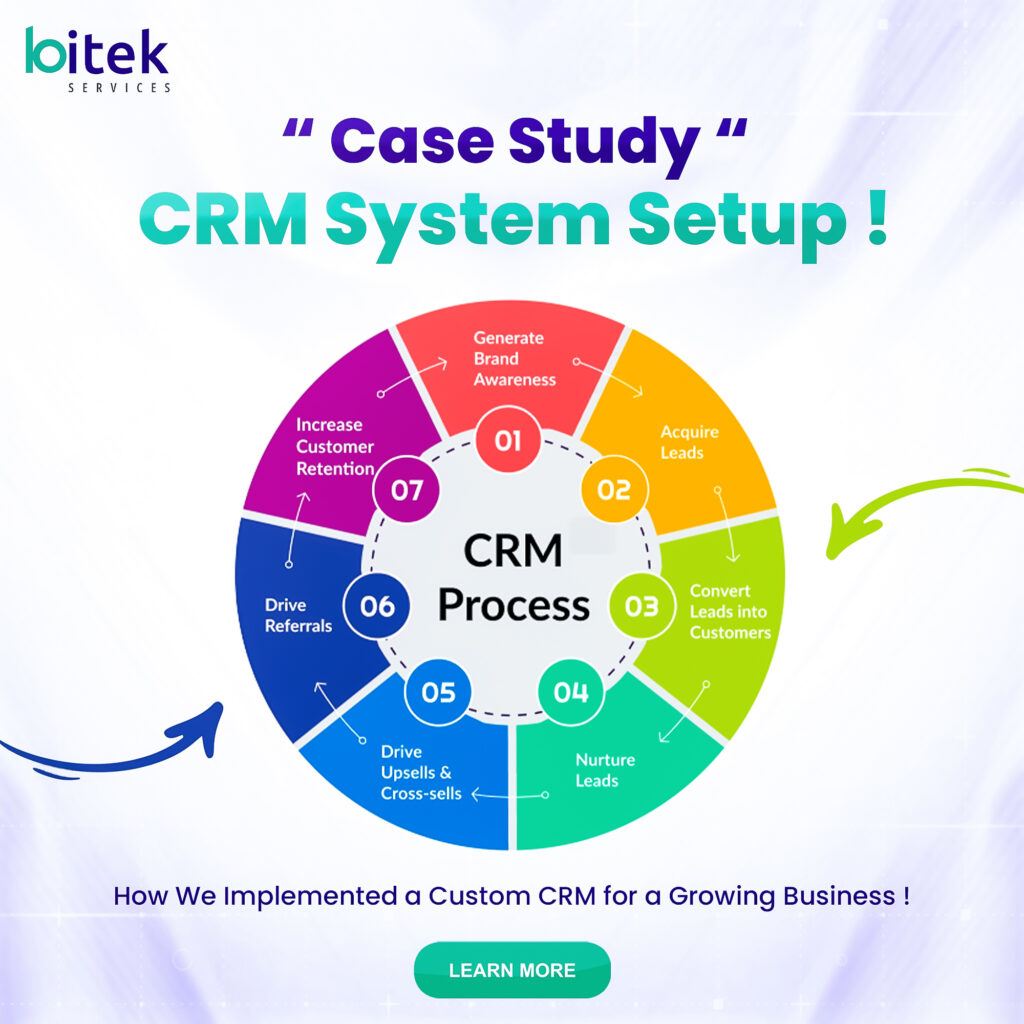
How We Implemented a Custom CRM for a Growing Business
Introduction
Growth is every business owner’s goal — until the systems that worked for a ten-person team start cracking under the weight of fifty. This is the story of how Bitek Services partnered with a fast-growing retail and e-commerce company to design, build, and deploy a custom CRM system that didn’t just solve today’s problems, but laid a foundation for the next phase of growth.
This case study walks through the full journey: the chaos we walked into, the thinking behind our solution, every phase of implementation, the technical decisions we made along the way, the human challenges of change management, and the measurable results that followed. Whether you’re a business owner considering a CRM, a operations manager drowning in spreadsheets, or a decision-maker trying to understand what a proper implementation actually looks like — this is a detailed, honest account of the work.
About the Client
Our client is a retail business operating across both a physical showroom and a growing e-commerce channel. At the time they engaged Bitek Services, they had been trading for six years and had experienced rapid growth over the preceding 18 months — largely driven by an expansion of their online product catalogue and a successful entry into two new regional markets.
The team had grown from 12 to 38 people in under two years. Their revenue had more than doubled. On paper, everything looked like a success story. Beneath the surface, however, the internal infrastructure — particularly around sales operations and customer data — was in a quiet state of crisis.
For confidentiality reasons, we refer to the client throughout this case study as “the Company.”
The Situation Before We Arrived
To understand why the CRM project mattered, it’s worth understanding exactly what the Company’s customer management looked like before Bitek Services got involved. The picture was one that will feel familiar to many growing businesses.
Customer data lived everywhere and nowhere. The Company had no single system of record for customer information. Contact details were spread across a shared Google Sheet maintained by the sales team, individual email inboxes, a legacy billing platform that had been in use since the company’s early days, and a collection of business cards and handwritten notes that various team members had accumulated over the years. When a new sales rep needed to follow up with a customer, they would often have to ask two or three colleagues whether anyone had spoken to that person recently — and even then, the information they received was incomplete.
There was no sales pipeline. The concept of a “pipeline” — a structured, stage-by-stage view of every active deal and its likelihood of closing — simply did not exist. The sales director had attempted to build one in a spreadsheet, but it was updated inconsistently and had been abandoned within a few weeks. When the founder asked for a revenue forecast, the answer was always a rough estimate based on gut feel rather than data.
Lead follow-up was unreliable. Inbound enquiries arrived through multiple channels — the website contact form, a general email address, phone calls, and occasionally via social media. There was no system for assigning these leads to specific reps, no agreed response time target, and no way of knowing whether a lead had been followed up at all. Some enquiries were falling through the cracks entirely and going unanswered for days.
Tools did not talk to each other. The Company used a popular e-commerce platform for online sales, a separate email marketing tool for newsletters and promotions, a standalone billing and invoicing system, and an accounting package. None of these systems shared data. If a customer purchased online, that transaction would not appear in any customer record visible to the sales team. If the marketing team sent a promotional email, there was no way to see whether a recipient had subsequently made a purchase. Every system operated in its own bubble.
Reporting was manual and slow. Producing any kind of customer or sales report required someone — usually a sales manager or operations coordinator — to manually export data from multiple systems, reconcile it in a spreadsheet, and format it into something presentable. This process took several hours each week and produced reports that were already out of date by the time anyone read them.
Onboarding new staff was painful. As the team grew, getting new sales reps up to speed on which customers existed, what their history was, and what outstanding opportunities were in play took weeks rather than days. There was no structured handover process because there was no structured data to hand over.
Why They Came to Bitek Services
The trigger for the engagement was a lost deal. A major wholesale enquiry had come in through the website contact form, sat unread in a general inbox for four days, and by the time someone picked it up, the prospective customer had already signed with a competitor. The value of that contract was significant enough to prompt the Company’s founder to make a decision that had been deferred for over a year: it was time to get serious about CRM.
They had looked at off-the-shelf CRM platforms before and felt overwhelmed by the options. They had also heard stories from peers about CRM implementations that had cost a great deal of money, generated enormous internal disruption, and ultimately been abandoned because the team never adopted them. They wanted a partner who would not just configure software, but who would take responsibility for the outcome.
That’s what brought them to Bitek Services.
Our Philosophy: Workflow First, Technology Second
Before we describe what we built, it’s worth explaining how Bitek Services approaches CRM projects — because the approach is as important as the outcome.
Many technology vendors start with a product and work backwards to the customer’s problem. They have a preferred platform, a standard configuration, and a deployment methodology shaped around that product. The client’s actual workflows are treated as something to be adapted to fit the tool, rather than the other way around.
At Bitek Services, we do the opposite. We start with a deep understanding of how the business actually operates — not how the org chart says it should operate, but how people actually behave on a Tuesday afternoon when they’re busy and under pressure. We map the real workflows, identify where data is created and where it gets lost, understand the informal processes that exist alongside the official ones, and only then do we make decisions about technology.
This philosophy has a practical implication: the discovery phase is non-negotiable. No matter how confident a client is that they already know what they need, we always invest in proper discovery before recommending or configuring anything. In the case of the Company, this paid off immediately — several of the most impactful features we ultimately built were ones that neither we nor the client had anticipated before the discovery work began.
Phase One: Discovery and Workflow Audit (Weeks 1–2)
The discovery phase lasted two weeks and involved the Bitek Services team spending significant time on-site with the Company, as well as conducting structured interviews and data audits remotely.
Stakeholder interviews. We conducted one-on-one interviews with 14 people across the business: the founder, the sales director, four sales reps, the marketing manager, the operations coordinator, two customer service team members, the e-commerce manager, the finance lead, and one recently joined junior sales rep whose fresh perspective proved particularly valuable. Each interview followed a structured guide but was run as an open conversation. We asked people to walk us through their typical day, describe how they interacted with customers, explain what information they needed to do their job well, and — critically — tell us what was most frustrating about the current situation.
The interviews surfaced a wealth of insight that no amount of system analysis could have revealed. We learned, for example, that the sales reps had developed an informal WhatsApp group to share customer updates with each other — a workaround born entirely from the absence of a proper shared system. We learned that the customer service team frequently had no idea what promises the sales team had made to a customer, leading to confused and sometimes contradictory conversations. We learned that the marketing manager had stopped segmenting email campaigns because pulling the data required to do so took too long and was too unreliable.
Process mapping. Following the interviews, we mapped every customer-facing process from end to end: how an inbound lead arrived and was handled, how a sales opportunity progressed from initial contact to closed deal, how an online order was processed and what happened if the customer subsequently contacted the business, how customer complaints were handled, and how customer data was used by the marketing team. Each process was documented as a flow diagram, shared with the relevant stakeholders for review, and annotated with the pain points and breakdowns identified in the interviews.
This mapping exercise identified seven distinct points in the customer journey where data was either lost, duplicated, or required manual re-entry. Four of these were identified as critical — meaning they were causing measurable business harm in the form of lost leads, delayed responses, or poor customer experience.
Data audit. We conducted a full audit of all existing customer data across every system the Company used. This included approximately 4,200 records in the shared Google Sheet, 1,800 records in the billing platform, and several hundred contacts scattered across individual email accounts. The audit revealed significant data quality issues: duplicate records for the same contact, missing contact information, outdated email addresses, and records that had no meaningful data beyond a name.
We also audited the Company’s existing software stack in detail, reviewing API capabilities and integration options for the e-commerce platform, email marketing tool, billing system, and accounting package. This technical audit informed the integration architecture we would later design.
Findings report. At the end of the discovery phase, we delivered a detailed findings report to the Company’s leadership team. The report documented the current state, identified the seven data breakdowns, quantified the business impact of each (in terms of time lost, leads missed, and revenue at risk), and set out our recommendations for the CRM solution. The report also included a proposed platform shortlist and a preliminary project plan.
Phase Two: Platform Selection and Architecture (Weeks 3–4)
With a clear picture of the Company’s needs in hand, we moved to platform selection. This is a stage that many vendors treat as a formality — they recommend the platform they know best, regardless of whether it’s the best fit. At Bitek Services, we treat it as a genuine decision that deserves rigorous evaluation.
The shortlist. Based on our discovery findings, we shortlisted three CRM platforms. Our evaluation criteria covered eight dimensions: flexibility of data model customisation, quality of the API for third-party integrations, mobile usability for reps working in the field, reporting and dashboard capabilities, ease of use for non-technical team members, total cost of ownership at the Company’s scale, quality of vendor support, and our own experience deploying the platform in similar contexts.
We shared the evaluation matrix with the Company’s leadership team and walked them through our reasoning. The selected platform was not the cheapest option, nor was it the most feature-rich. It was the one that best matched the Company’s specific needs: highly customisable pipeline and contact data structures, a clean and intuitive interface that we were confident the sales team would actually use, strong API capabilities that would support the integrations we needed to build, and robust mobile apps for reps on the road.
CRM architecture design. Once the platform was selected, we designed the full CRM architecture before touching any configuration. This meant defining the complete data model: what objects (contacts, companies, deals, activities) would exist in the system, what custom fields would be added to each, how records would relate to each other, what the pipeline stages would be, what automation rules would be applied, and what user roles and permission levels would be created.
The pipeline design was a particularly involved process. The Company’s actual sales cycle had nine distinct stages from first contact to closed deal — far more nuanced than the generic three or four-stage defaults that most CRM platforms ship with. We worked through each stage with the sales director, defining entry criteria, exit criteria, the typical time a deal would spend at each stage, and what actions a rep was expected to take. This pipeline design became the backbone of the entire CRM configuration.
We also designed the integration architecture at this stage: a data flow diagram showing exactly how information would move between the CRM and each connected system, what data would be synced in which direction, how conflicts would be resolved, and what the error handling and alerting logic would look like.
Phase Three: Data Migration and Integrations (Weeks 5–6)
With the architecture designed and signed off, we moved into the most technically intensive phase of the project: migrating the existing data and building the integration layer.
Data cleaning and preparation. Before migrating anything, we undertook a thorough data cleaning exercise. The combined dataset from all sources — after deduplication — contained 6,240 unique contact records. We wrote custom scripts to identify and merge duplicate records, standardise field formats (phone numbers, postal addresses, email addresses), flag records with critical missing data for manual review, and apply the correct data structure for import into the new CRM.
The cleaning process took longer than anticipated. We had estimated three days; it took five. The primary reason was the volume of duplicate records — many contacts appeared in both the Google Sheet and the billing platform, often with slightly different data in each version. Resolving these duplicates required judgment calls that couldn’t be automated, and we involved the Company’s sales team in reviewing the most ambiguous cases. This investment of time was worthwhile: the Company went live with a clean, reliable dataset rather than inheriting the problems of the old one.
CRM configuration. In parallel with the data work, our configuration team built out the full CRM environment according to the architecture design. This included creating all custom fields and objects, configuring the nine-stage sales pipeline, building the automated lead assignment rules, setting up user accounts and permission levels for all 38 team members, configuring email integration so that all customer correspondence was automatically logged, building the management dashboard views, and creating the email sequence templates for the automated follow-up cadences.
The automated lead assignment logic deserved particular attention. Inbound leads from the website needed to be routed to the correct rep based on two variables: the geographic region of the enquiry and the product category of interest. We built a rule engine within the CRM that evaluated these variables against a routing matrix and assigned the lead accordingly, while also triggering an immediate notification to the assigned rep and starting a response-time timer that would escalate to the sales director if not acted upon within four hours.
Integration development. We built four integrations during this phase.
The e-commerce integration was the most complex. We used the e-commerce platform’s API to build a real-time, two-way sync between online orders and CRM contact records. Every time a customer placed an order, their CRM record was automatically updated with the transaction details, including product, value, date, and order status. Returns and refunds were also synced. This meant that any sales rep opening a customer record could immediately see that person’s full purchase history without leaving the CRM.
The email marketing integration connected the CRM to the Company’s existing newsletter and campaign platform. Contact segments defined in the CRM were automatically reflected in the email tool, allowing the marketing team to send targeted campaigns to specific customer groups — for example, customers who had purchased from a specific product category but not returned in 90 days — without any manual data export or import.
The billing system integration created a one-way sync of invoice and payment data into the CRM, so the customer service team could see whether a customer had any outstanding invoices when handling a support call.
The accounting integration provided a simple outbound sync of closed-deal data to the accounting package, eliminating the manual re-entry of deal values that the finance team had previously performed.
Phase Four: Training and Go-Live (Weeks 7–8)
A CRM is only as good as the people using it. This is not a cliché — it is the single most common reason CRM implementations fail. Companies invest in excellent technology, deploy it carefully, and then hand it to their team with a one-hour overview session and wonder why adoption stalls within weeks. At Bitek Services, training is a first-class component of every implementation, not an afterthought.
Training programme design. We designed a role-based training programme rather than a single generic session. Different people in the Company needed to use the CRM in fundamentally different ways: a field sales rep needed to know how to log a call, update a deal stage, and check a customer’s purchase history quickly from their phone; a sales manager needed to understand pipeline reporting and forecast views; a marketing manager needed to understand contact segmentation and campaign sync; a customer service rep needed to be able to pull up a full customer record during a live call. One-size-fits-all training fails all of these people.
We ran six separate training sessions over four days, grouped by role. Each session was between 90 minutes and two hours, included hands-on practice with real (sanitised) data, and ended with a Q&A. We also recorded each session for future reference and created role-specific quick-reference guides — one-page summaries of the key tasks each role would perform — which were printed and distributed to every team member.
Resistance and change management. It would be misleading to suggest that every team member welcomed the new system with enthusiasm. Change is disruptive, and some of the Company’s more experienced sales reps were sceptical. One veteran rep with 11 years at the Company was openly resistant, arguing that the new system would slow him down and that his existing method of managing customer relationships in his inbox had served him well enough. This is a common dynamic in CRM rollouts and one that Bitek Services has navigated many times.
Our approach was not to override resistance but to address it directly. We spent additional time with the sceptical rep, understanding his specific concerns, showing him how the mobile app would allow him to log calls with a single tap, and demonstrating how the automated follow-up sequences would handle reminders that he was currently tracking manually. By the end of the training week, his position had shifted from opposition to cautious willingness. By day 30 of live operation, he was one of the system’s heaviest users.
Go-live and hypercare. The system went live at the start of week eight. Rather than a hard cutover — immediately shutting off all old systems — we ran a parallel period for five days during which reps were expected to use the CRM as their primary system but could still reference the old Google Sheet if needed. This reduced anxiety and gave people a safety net during the adjustment period.
For the first two weeks after go-live, a Bitek Services consultant was available daily — reachable via a dedicated Slack channel — to answer questions, resolve issues, and address any configuration adjustments needed. We logged 47 support queries during this hypercare period. The majority were simple how-to questions; several led to minor configuration tweaks; one identified a bug in the e-commerce integration that we resolved within 24 hours.
Technical Challenges and How We Solved Them
No implementation of this complexity goes entirely smoothly, and transparency about the challenges we encountered is part of what makes this case study useful.
The duplicate record problem. As noted in the data migration section, the volume of duplicate records was higher than our initial estimate. The deeper issue was that the same person had sometimes been entered into the billing system under a company name and into the Google Sheet as an individual — meaning automated deduplication based on email address or phone number was not sufficient. We solved this by building a custom matching algorithm that considered multiple fields in combination and flagged probable duplicates for human review. The process added two days to the timeline but resulted in a significantly cleaner dataset.
API rate limiting on the e-commerce platform. During the initial testing of the e-commerce integration, we discovered that the volume of historical order records we needed to import would exceed the platform’s API rate limits. We redesigned the import process to run in batches over 72 hours rather than as a single bulk operation, which resolved the issue without any data loss.
User permission complexity. The Company had a more complex permission structure than we had initially anticipated — there were two sales teams operating semi-independently for different product lines, each with its own manager, and neither team should be able to see the other’s pipeline data in detail. Building this data separation within the CRM while still allowing senior leadership to see a consolidated view required careful configuration of role hierarchies and visibility rules. The solution worked, but it added half a day to the configuration timeline.
Email sync conflicts. When we activated the email integration, we found that several reps had been using personal email addresses rather than their company addresses for some customer correspondence. This meant that some customer email history was not being captured by the CRM. We could not force reps to stop using personal addresses immediately, so we implemented a simple BCC forwarding rule that allowed them to manually include customer correspondence in the CRM when needed, while we worked with the sales director to establish a company policy requiring the use of official email addresses going forward.
Results at 60 Days
Sixty days after go-live, we conducted a formal review with the Company’s leadership team. The results were measured against the baseline metrics we had established during the discovery phase.
Lead response time fell from an average of 26 hours to under 8 hours — a reduction of nearly 70%. The automated lead assignment and four-hour escalation rule had transformed what had previously been an inconsistent, informal process into a reliable, measurable one. The lost-deal scenario that had triggered the engagement had not recurred.
CRM adoption across the sales team reached 98%, measured by the percentage of reps logging at least one activity per day. The one team member not yet fully active had been on extended leave and was onboarding upon their return. This adoption rate significantly exceeded the industry benchmark for CRM rollouts of comparable size, which typically sits between 60% and 75% at the 60-day mark.
Manual data entry time was reduced by approximately 40%, measured by a self-reported time audit conducted with six members of the team. The primary drivers were the automated e-commerce sync, which eliminated manual logging of online customer interactions, and the email sequence automation, which handled follow-up reminders that reps had previously been setting manually in their calendars or inboxes.
Duplicate customer records were reduced from an estimated 23% of the total dataset to under 1%, as measured by a spot audit of 200 randomly selected records at the 60-day mark. The ongoing deduplication rules we had configured were catching and flagging new duplicates before they entered the system.
Pipeline visibility was described by the sales director and founder as “transformational” — a qualitative rather than quantitative outcome, but one that the leadership team consistently cited as the most valuable change. The ability to open a dashboard and see the full pipeline at any moment, with deal values, stage distributions, and activity levels, had changed the nature of the weekly sales meeting from a status-update session to a genuine strategic conversation.
Revenue forecasting accuracy, while harder to measure definitively at the 60-day mark, was directionally improved. The sales director reported that his confidence in revenue projections had increased significantly, and the first quarterly forecast produced using CRM pipeline data was described as the most reliable the Company had ever produced.
What the Team Said
Beyond the metrics, the human experience of the transition mattered. We gathered structured feedback from 22 team members at the 60-day mark.
The most commonly cited positive change was the ability to see a complete picture of a customer before engaging with them — knowing their purchase history, previous conversations, and any open service issues without having to ask anyone or dig through emails. Multiple reps described this as making them feel more confident and better prepared in customer conversations.
The mobile app was highlighted by field-based reps as a significant practical improvement. The ability to log a call or update a deal stage immediately after a customer meeting, rather than trying to remember to do it later from a desktop, had improved both data quality and the reps’ own sense of organisation.
The automated follow-up sequences were popular with the team members who had been most burdened by manual reminder-setting. One rep estimated she had been spending 45 minutes per day managing follow-up reminders across her inbox and calendar; with the automation in place, that time had essentially dropped to zero.
The most common criticism was that the initial training period had felt rushed — a fair point, and one that reflected the Company’s desire to go live within the eight-week timeline we had agreed. If the project were repeated, we would advocate for a longer parallel-running period and more structured coaching in the first weeks post-launch.
Lessons for Growing Businesses
This project reinforced several principles that Bitek Services applies across all of its CRM engagements. They are worth sharing directly.
Clean data is a precondition, not a nice-to-have. Migrating messy data into a new system does not fix the problem — it just gives the problem a new home. Investing in data cleaning before migration is always worth the time and cost.
Adoption is a design problem. If your team doesn’t use the CRM, it doesn’t matter how well it’s configured. Adoption is not about convincing reluctant people to change their habits — it’s about designing a system that fits into how people actually work, and providing enough support during the transition period to build confidence. The training programme, the hypercare period, and the role-specific quick-reference guides were all parts of a deliberate adoption strategy.
Integrations multiply the value of a CRM. A CRM that sits in isolation, requiring manual data entry from other systems, will always feel like a burden. A CRM that receives data automatically from your e-commerce platform, email tool, and billing system feels like a source of truth — because it is one.
Start with the pipeline design. The pipeline is the heart of a CRM. Getting it right — defining stages that reflect how your business actually sells, with clear entry and exit criteria — is more important than any other configuration decision. If the pipeline doesn’t reflect reality, the data will never be trusted, and the system will drift into disuse.
The discovery phase pays for itself. Every hour spent understanding how a business actually works before touching any technology saves multiple hours of rework later. The e-commerce sync, the automated lead routing, and the role-based training programme were all born from discoveries made during the two-week audit — none of them were in the original brief.
Conclusion
When the Company first called Bitek Services, they had a lost deal, a frustrated founder, and a growing sense that their internal operations were not keeping pace with their commercial ambitions. Eight weeks later, they had a fully operational CRM system, a clean and consolidated customer database, four live integrations connecting their key business platforms, a trained and largely enthusiastic team, and measurable improvements across every metric that had been identified as a problem.
None of that happened because we installed good software. It happened because we took the time to understand the business, designed a solution around how the Company actually works, built it carefully, and invested in making sure the team could use it confidently.
That is what Bitek Services does — and it is what separates a successful CRM implementation from one that ends up as an expensive disappointment.
Bitek Services works with growing businesses to design, implement, and optimise CRM systems that deliver real operational impact. If your business is ready to move beyond spreadsheets and disconnected tools, we’d be glad to start a conversation.


