
How DevOps Helped a Client Deploy 5x Faster
Speed matters in software development. The faster you can deploy changes, the quicker you can deliver value to customers, respond to market opportunities, and fix problems. When a growing SaaS company approached Bitek Services struggling with slow, error-prone deployments that took days to complete, we saw an opportunity to demonstrate the transformative power of modern DevOps practices. This is the story of how we helped them accelerate from deploying once every two weeks to deploying multiple times daily—a 5x improvement in deployment frequency with dramatically improved reliability.
The Client’s Deployment Nightmare
Our client, a B2B software platform serving mid-sized enterprises, had reached an inflection point. Their product was successful, customer demand was growing, and their development team had expanded from 5 to 25 engineers. But their deployment process hadn’t scaled with their growth.
Deployments were manual, complex affairs requiring a full day of coordinated effort from multiple team members. The process involved manual code merges from feature branches, running test suites on local machines, manually building and packaging applications, uploading builds to staging servers via FTP, manual configuration changes on servers, database migration scripts run by hand, smoke testing to verify basic functionality, and finally deploying to production during designated maintenance windows—typically late Friday nights or Sunday mornings.
The consequences were severe. Deployments happened only every two weeks because they were so painful that no one wanted to do them more frequently. Features took weeks to reach customers even after development completed. Bug fixes required waiting for the next deployment window, meaning critical issues sometimes persisted for days. Deployment failures happened in 30% of attempts, requiring rollbacks and frantic troubleshooting.
The development team’s morale suffered. Developers spent their weekends handling deployments instead of enjoying time with families. The fear of deployment failures created conservative, risk-averse culture. Innovation slowed because releasing new features was so painful.
“We were spending more time fighting our deployment process than building features,” the CTO told Bitek Services during our initial consultation. “Every deployment felt like defusing a bomb. We needed to fundamentally change how we deliver software.”
Understanding the Root Problems
Bitek Services began with a thorough assessment of their current deployment process. We documented every step, identified pain points, and analyzed where failures typically occurred. Several fundamental problems emerged.
Manual processes created inconsistency. Each deployment involved hundreds of manual steps. Human error was inevitable—forgotten steps, incorrect configurations, mistyped commands. No two deployments were exactly alike.
Lack of automation meant no repeatability. Because everything was manual, there was no guaranteed way to recreate successful deployments or roll back failed ones. Each deployment was a unique snowflake.
Inadequate testing caught problems too late. Testing happened after code was already merged and packaged. Discovering issues at this stage meant rework was expensive and time-consuming.
No continuous integration meant integration hell. Developers worked in isolation on feature branches for weeks. When they finally merged, conflicts and integration issues created hours of painful resolution work.
Manual configuration management created drift. Production, staging, and development environments had subtly different configurations because changes were applied manually to each. This drift meant “works on my machine” problems regularly appeared in production.
Deployment windows constrained velocity. Restricting deployments to specific maintenance windows meant waiting days or weeks to deploy ready code, creating artificial constraints on delivery speed.
At Bitek Services, we recognized these as classic symptoms of organizations that had grown beyond their original processes without updating their practices. The solution required comprehensive DevOps transformation, not just automation of existing broken processes.
Designing the DevOps Pipeline
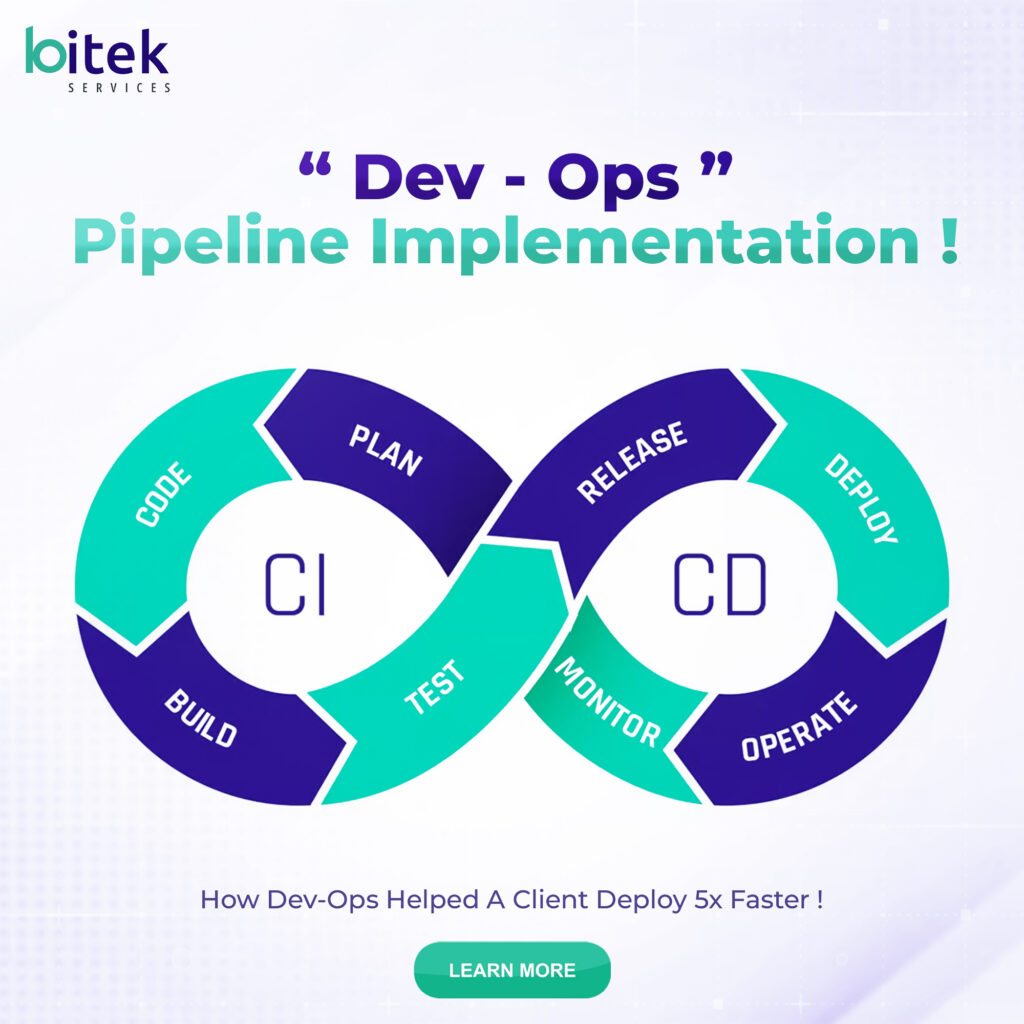
We designed a comprehensive CI/CD (Continuous Integration/Continuous Deployment) pipeline that would automate the entire journey from code commit to production deployment. The pipeline needed to be reliable, fast, secure, and provide visibility into every stage.
The architecture consisted of several integrated components working together. Version control centralized all code in Git with branch protection rules enforcing code review requirements. Continuous integration automatically built and tested every code change. Artifact management stored versioned, immutable build artifacts. Infrastructure as code defined all infrastructure in version-controlled templates. Automated testing ran comprehensive test suites at multiple pipeline stages. Deployment automation handled zero-downtime deployments to all environments. And monitoring and observability provided real-time visibility into deployments and application health.
We chose Jenkins as the CI/CD orchestration platform for its flexibility and extensive plugin ecosystem. Docker containerized applications for consistency across environments. Kubernetes orchestrated container deployment for scalability and resilience. Terraform managed infrastructure as code. And Ansible handled configuration management.
The technology choices mattered less than the principles—automation, consistency, speed, and reliability. We could have achieved similar results with different tools, but these provided the best fit for the client’s specific needs and technical expertise.
Phase 1: Continuous Integration
We began by implementing continuous integration—automatically building and testing code with every commit. This foundational change established quality gates early in the development process.
We configured Jenkins to monitor the Git repository and trigger builds automatically when developers pushed code. Each build followed a consistent process: pull latest code from the repository, install dependencies, compile/build the application, run unit tests, run integration tests, perform static code analysis, and generate build artifacts.
If any step failed, the build failed and developers received immediate notification. This fast feedback—typically within 5-10 minutes of committing code—meant problems were caught when they were fresh in developers’ minds and easy to fix.
We established branch protection rules requiring all pull requests to pass CI checks before merging. No broken code could enter the main branch. This discipline prevented the integration hell that had plagued previous processes.
The impact was immediate. Integration problems that used to surface during painful merge sessions now appeared during development when they were easy to address. The quality of code entering the main branch improved dramatically. Developers gained confidence that passing CI meant their changes worked correctly.
At Bitek Services, we trained the development team on interpreting build results, fixing failures quickly, and maintaining the CI pipeline. Within two weeks, CI had become an essential part of their workflow that no one could imagine working without.
Phase 2: Automated Testing
Testing is critical to deployment confidence. You can’t deploy quickly if you’re unsure whether changes will break production. We implemented comprehensive automated testing at multiple levels.
Unit tests verified individual components in isolation, running in seconds and catching logic errors early. Integration tests verified components worked together correctly, testing database interactions, API calls, and service integrations. End-to-end tests simulated real user workflows through the complete application, catching issues that only appear in realistic scenarios. Performance tests ensured changes didn’t degrade system performance. And security scans identified vulnerabilities in code and dependencies.
We organized tests into stages with different execution triggers. Unit tests ran with every commit—they were fast and caught most problems. Integration tests ran on pull requests before merging. Full end-to-end tests ran nightly and before production deployments. Performance tests ran weekly and before major releases.
This tiered approach balanced thoroughness with speed. Developers got fast feedback from unit tests while comprehensive testing happened before production deployment.
We also implemented test coverage tracking, establishing minimum coverage thresholds that builds had to meet. This prevented the test suite from degrading over time as new code was added without tests.
The automated testing suite caught bugs that would have reached production in the old process. Post-deployment bug reports dropped by 70% within the first month. The team’s confidence in deploying grew as testing proved reliable.
Phase 3: Infrastructure as Code
Manual server configuration created the drift and inconsistency that made deployments unreliable. We implemented infrastructure as code to define all infrastructure in version-controlled configuration files.
Using Terraform, we codified the complete infrastructure—compute instances, databases, load balancers, networking, security groups, and storage. This code lived in Git alongside application code, providing the same version control, code review, and automation benefits.
Creating new environments became trivial. Instead of manually configuring servers following documentation that was inevitably outdated or incomplete, we ran Terraform scripts that created identical environments in minutes. Development, staging, and production environments were now truly consistent because they were created from the same code.
Infrastructure changes went through the same review process as application code. Engineers submitted pull requests with infrastructure changes, colleagues reviewed them, and automated tests validated them before deployment. This discipline prevented configuration mistakes that had caused previous outages.
We also implemented Ansible for application configuration management, ensuring applications were configured identically across environments. The combination of Terraform for infrastructure and Ansible for configuration eliminated the environmental drift that had caused “works in staging but not in production” problems.
At Bitek Services, we documented the infrastructure code thoroughly and trained operations staff on maintaining it. Infrastructure became reproducible, testable, and reliable rather than tribal knowledge locked in individuals’ heads.
Phase 4: Containerization with Docker
Containers provided consistency between development and production environments while simplifying deployment. We containerized all applications using Docker.
Each application component became a Docker image containing the application, its dependencies, and runtime environment. These images were identical whether running on a developer’s laptop, staging servers, or production clusters. “It works on my machine” ceased being a valid excuse because everyone ran the same containers.
We implemented a container registry to store versioned images. Each successful build produced a tagged image pushed to the registry. Deployment meant pulling specific image versions and running them—no compilation, no dependency installation, just running pre-built, tested containers.
Docker Compose defined multi-container applications for local development, giving developers production-like environments on their laptops. Developers could spin up the entire application stack locally with a single command, dramatically improving development efficiency.
Containerization also enabled efficient resource utilization. Instead of dedicating entire virtual machines to single applications, multiple containers ran on shared hosts, improving density and reducing infrastructure costs.
The transition to containers took three weeks including developer training. The investment paid immediate dividends in consistency and deployment simplicity.
Phase 5: Kubernetes Orchestration
Running containers is one thing; orchestrating them at scale is another. We implemented Kubernetes to manage container deployment, scaling, and operation in production.
Kubernetes provided several critical capabilities. Automated deployment rolled out new versions with zero downtime. Self-healing automatically restarted failed containers. Auto-scaling adjusted capacity based on load. Service discovery handled networking between components. Load balancing distributed traffic across instances. And rollback quickly reverted problematic deployments.
We defined Kubernetes manifests describing desired application state—how many instances of each component, resource requirements, networking configuration, and health checks. Kubernetes ensured actual state matched desired state continuously.
Deployments became declarative. Instead of imperative commands telling servers what to do, we updated manifests describing what the application should look like, and Kubernetes made it happen. Rolling updates gradually replaced old versions with new ones, monitoring health and rolling back automatically if problems appeared.
The operations team initially found Kubernetes complex, but Bitek Services provided extensive training and documentation. Within a month, Kubernetes had become their preferred deployment platform. The reliability and capabilities it provided were transformative.
Phase 6: Continuous Deployment
With all the foundational pieces in place—CI, automated testing, infrastructure as code, containers, and orchestration—we implemented continuous deployment: automatically deploying changes to production when they passed all quality gates.
We started with continuous deployment to staging. Every commit to the main branch that passed tests automatically deployed to staging within minutes. This provided a constantly updated staging environment reflecting the latest code.
For production, we implemented a phased approach. Initially, deployments still required manual approval but were automated once approved. This gave the team confidence in the automation while maintaining human oversight.
After two weeks of successful automated deployments to staging and manual-approval production deployments, we enabled full continuous deployment. Code merged to main automatically deployed to production after passing all tests. The team could deploy multiple times daily with confidence.
We implemented deployment safeguards to manage risk. Blue-green deployments maintained two production environments, routing traffic to the new version only after validation. Canary deployments gradually rolled out changes to small user percentages before full deployment. Feature flags allowed deploying code with features disabled, enabling them independently of deployment. And automated rollback reverted deployments automatically if health checks failed.
These safeguards meant continuous deployment didn’t mean reckless deployment. Changes reached production quickly but safely, with multiple checkpoints preventing problems from impacting users.
The Remarkable Results
The transformation was profound and measurable. Deployment frequency increased from once every two weeks to 5-8 times per day—a 5x improvement in deployment velocity. Deployment time decreased from 8 hours to 20 minutes from commit to production. Deployment failure rate dropped from 30% to under 5%. And time to recover from failures decreased from hours to minutes through automated rollback.
Beyond quantitative metrics, qualitative improvements were equally significant. Developer productivity increased as they spent time building features rather than managing deployments. Developer satisfaction improved dramatically—no more weekend deployment marathons. Time to market for new features decreased from weeks to days. And bug fix deployment time dropped from days to hours.
The business impact was substantial. The faster feedback loop enabled true agile development where customer feedback informed development within days rather than months. The ability to deploy fixes immediately reduced the impact of production issues. The confidence in deployment encouraged experimentation and innovation. And the reduced time on deployment operations freed budget for feature development.
“The transformation has been incredible,” the CTO shared. “We went from dreading deployments to not even thinking about them. Deployment became a non-event—it just happens. That mental shift alone was worth the investment. Now we focus on building great products, not fighting our deployment process.”
Cultural Transformation
Technology changes were only part of the story. DevOps implementation required cultural changes that were equally important and often more challenging.
Breaking down silos meant developers and operations became a unified team with shared goals and shared responsibility. The adversarial “throw it over the wall” relationship transformed into collaborative partnership.
Embracing failure as learning opportunities rather than blame opportunities created psychological safety for experimentation. Post-mortems focused on system improvements rather than individual fault.
Measuring and improving became continuous practices. The team tracked key metrics—deployment frequency, lead time, change failure rate, and recovery time—and continuously optimized them.
Automating everything possible became a core value. Manual processes were viewed as technical debt requiring elimination.
At Bitek Services, we facilitated this cultural transformation through training, coaching, and demonstrating better ways of working. The technology enabled the culture, and the culture sustained the technology improvements.
Ongoing Evolution
DevOps implementation wasn’t a project with an end date—it established practices and infrastructure for continuous improvement. The client continues evolving their pipeline with Bitek Services’ ongoing support.
Recent enhancements include advanced monitoring and observability with distributed tracing, chaos engineering to proactively identify failure modes, progressive delivery with sophisticated feature flag management, infrastructure cost optimization through right-sizing and auto-scaling, and security scanning integrated throughout the pipeline.
The team now views the pipeline as critical infrastructure requiring investment and maintenance, not just a one-time implementation.
Key Lessons Learned
This transformation reinforced several important principles. Start with CI, not CD. Continuous integration establishes the foundation for everything else. Without reliable CI, continuous deployment is reckless. Automate incrementally, not all at once. Each phase built on previous phases. Trying to implement everything simultaneously would have overwhelmed the team.
Invest in testing. Deployment confidence comes from comprehensive testing. Without robust tests, automation just fails faster. Cultural change matters as much as technical change. Technology alone doesn’t create DevOps. People and processes are equally important.
Measure everything. Metrics prove value and guide improvement. What gets measured gets improved. And get organizational buy-in. DevOps transformation requires support from development, operations, and leadership.
The Bitek Services DevOps Approach
At Bitek Services, we approach DevOps transformation holistically, combining technology implementation with cultural coaching. We assess current state comprehensively, design solutions appropriate for specific contexts and organizational maturity, implement incrementally with quick wins building momentum, provide extensive training and knowledge transfer, and offer ongoing support as practices mature.
We recognize that every organization is different—different technology stacks, different team structures, different cultural starting points. We tailor implementations rather than applying cookie-cutter solutions.
Most importantly, we measure success by business outcomes, not just technology implementation. A technically perfect pipeline that doesn’t improve business results is a failure. We focus on delivering measurable improvements in speed, quality, and reliability.
Is Your Organization Ready?
If you’re experiencing any of these symptoms, DevOps transformation could transform your operations: slow, painful deployments limiting release frequency, high deployment failure rates requiring frequent rollbacks, fear of deploying preventing innovation, manual processes consuming excessive time, environmental inconsistencies causing production issues, or inability to respond quickly to market opportunities or customer needs.
DevOps isn’t just for tech giants or Silicon Valley startups. Organizations of any size in any industry can benefit from modern deployment practices. The investment pays returns quickly through increased velocity and reduced operational burden.
Conclusion
This client’s journey from deploying every two weeks to deploying multiple times daily demonstrates what’s possible with modern DevOps practices. The transformation wasn’t just about technology—it was about establishing practices, building culture, and creating infrastructure for continuous improvement.
The 5x improvement in deployment frequency was just one metric. The real transformation was in the team’s ability to deliver value to customers quickly, confidently, and reliably. They moved from deployment being a constraint on their business to deployment being an enabler of competitive advantage.
If your organization struggles with slow, unreliable deployments, know that better approaches exist. DevOps transformation requires investment and commitment, but the returns—in speed, quality, developer satisfaction, and business outcomes—justify that investment many times over.
Ready to transform your deployment process? Contact Bitek Services for a DevOps assessment. We’ll evaluate your current deployment practices, identify opportunities for improvement, and develop a roadmap for implementing modern CI/CD practices that dramatically accelerate your software delivery. Let’s help you deploy with confidence and speed.


